Yesterday I saw on Brickset that a LEGO set I wanted was on sale on Amazon. Later that day when I went to look again, Brickset no longer listed the new Imperial Shuttle in its sales section. So, in the interest of checking if it was out of stock or if the sale was over, I popped open a new tab and searched Amazon for the set I wanted.
And geez, Amazon sucks man.
Allow me to explain.
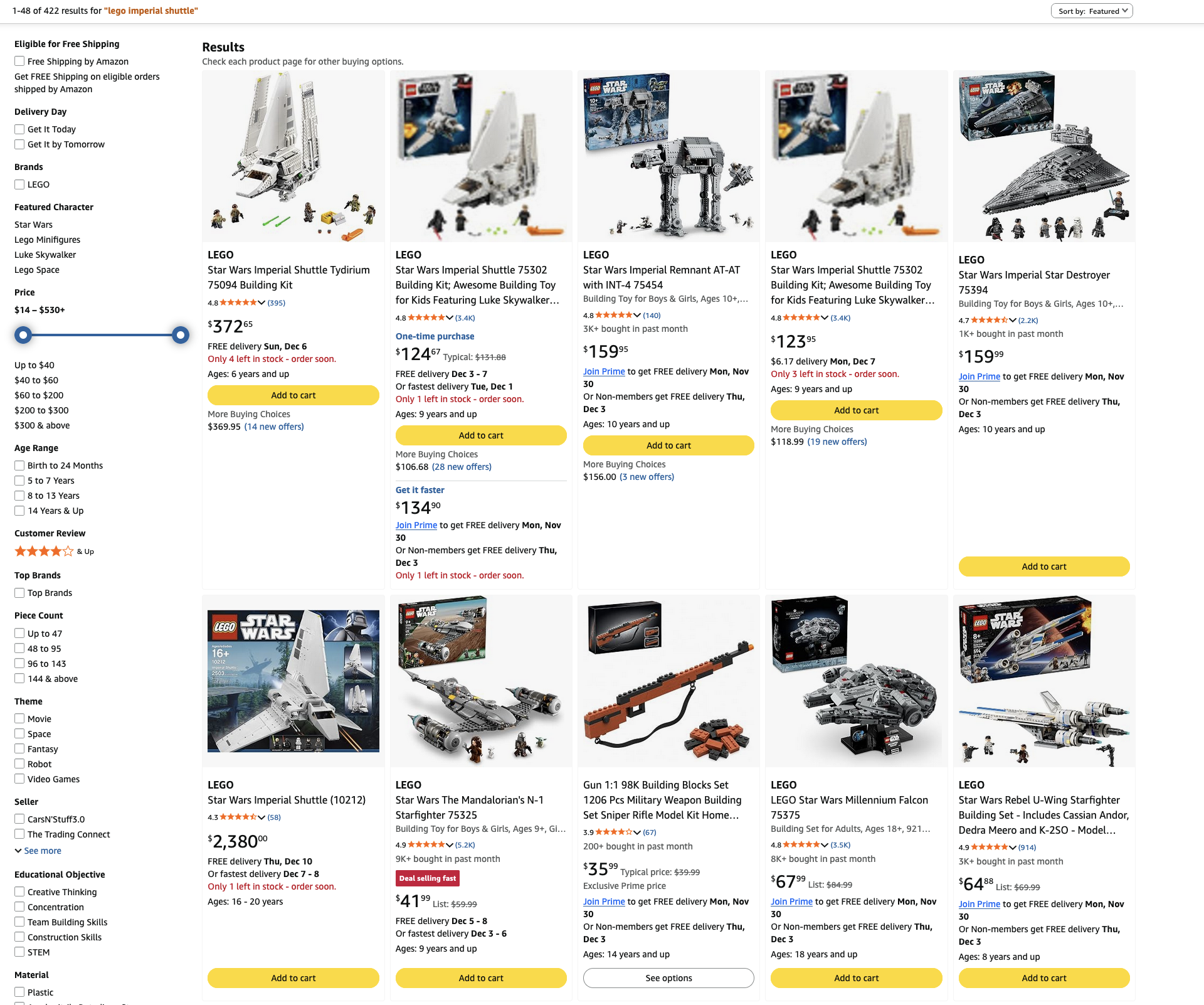
While there are three Imperial Shuttles in the results, the first one came a decade years ago. The second one is from four years ago (and is there twice in the results, also fourth). The third shuttle (in fifth place) is even older, having been released in 2010. There’s also a knock off toy gun in the first eight results.
What if I search the set I want by its set number?
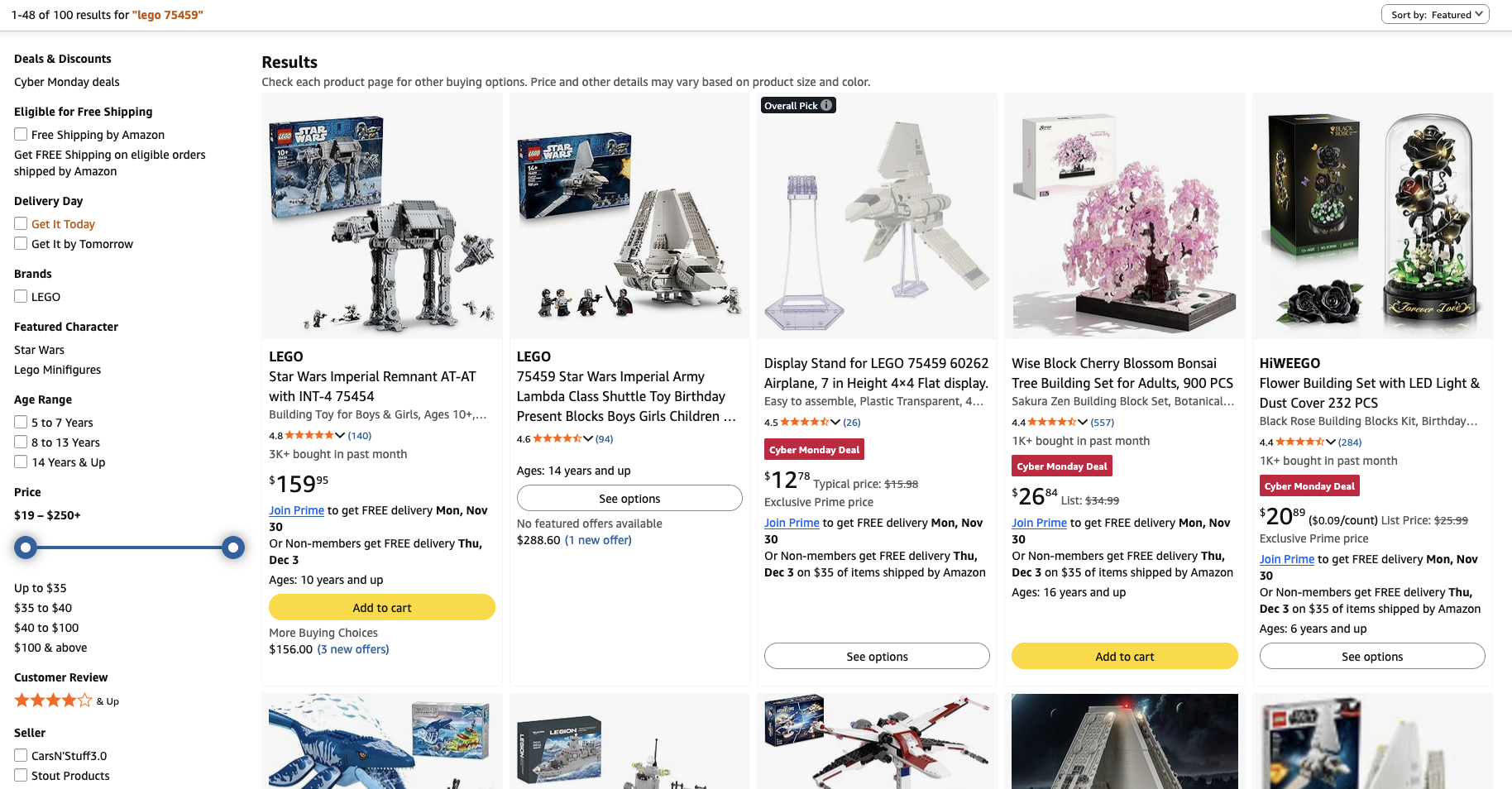
There it is! In second place, after another Star Wars set. Which, alright, fair, Amazon’s search algorithm is probably designed to not put an out-of-stock item in first place. The rest of the results are more knock-off sets, a stand, a lighting kit, and the 2021 set again. And all this is if I have the set number and don’t just search ‘Imperial Shuttle”1. At best, this is a lousy way to browse for products (it’s annoying to see non-LEGO results and older sets when, maybe, I’d like to see what sets are actually available right now) and, at worse, this is predatory as hell.
Let’s go back to the first results and the three older Shuttles. The shuttle that I’m looking for has an MSRP of $139.99. At first glance, the set from 2021 (#7302) seems comparable. But. The set originally retailed for $100. “Ah, but Josh,” you say, “LEGO sets are often quite pricey after they’ve been discontinued.” And you would be right – sometimes. A quick peek at Bricklink (the website for the LEGO aftermarket) tells me I could grab a new, sealed one for $75. While the other two have appreciated on the aftermarket, Amazon’s prices are still far above what they go for elsewhere. The 2015 set(75094): MSRP of $100, Available on Bricklink for $250, Amazon lists for $372; the UCS set from 2010: MSRP of $260, Available on Bricklink for $2,0002, Amazon lists for $2,380.
Importantly, this is on Amazon. This is a website that advertises itself as where to do your Christmas shopping and buy your home goods and pet food. Hunting down a discontinued LEGO set is the sort of thing you’d do on eBay (which, incidentally, have prices that are comparable to Bricklink). I am someone who’s in the weeds of LEGO, so I know this stuff. But for someone less familiar with it, wow is this a minefield. These marked-up old sets are presented with the same formality as currently available sets, as you would find them on the shelves of a reputable store. Spare a thought for the grandparent going through a Christmas list and getting fleeced. Amazon, meanwhile, they still get their cut of sales.
That buying LEGO is such a crapshoot on Amazon gives me pause when I’m shopping for something I know less about. Looking for a new shirt, cookware, or gifts for friends and family — wading through Amazon to find whatever it is I’m after feels like a fraught exercise in buyer beware. Finding out whether you’re looking at the actual product as described and getting a fair deal has become a whole ordeal.
I wish I had a tidy conclusion to this beyond a reiteration that capitalism sucks, man. Amazon’s gone from being just a retailer to a retailer and a platform for other retailers to do as they will. And yes, Amazon is awful but it’s the place to do your online shopping (A quick check shows that Walmart isn’t much better [Target, for now, actually reflects what you’d currently find in stores]). It’s depressing and maddening to see what once used to be a reliable and trustworthy website become one that will happily let you be ripped off. The internet doesn’t have to be like this and, for a while there, it wasn’t like this. But there’s money to be made and Bezos and buddies need more yachts, so, well, buyer beware.

