I cracked open Instagram the other day for my once-a-day-if-I-remember foray into social media. I flicked through the photos on a friend’s post, seeing what she was up to, and then scrolled down only to be greeted by an ominous question:
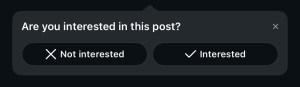
I was, initially, confused. This is the sort of thing I would see on ads and duly select not interested in a futile attempt to cull invasive advertising from my life. Why was this showing up below the post of a friend, someone who I’ve willingly chosen to interact with?
Then the other implications slowly dawned on me. I, naively, still use social media as a social network: to keep up with friends. (Instagram itself I still treat like that hipster photo app.) This is not what social media has become. You are meant to follow accounts that seem interesting and keep scrolling as the algorithm suggests more to you as you consume an unending stream of content and advertising. You are asked if you are interested in a post to optimize your experience — insofar as your experience is to spend as much time on the app and consume, consume, consume. That you might be genuinely interested in keeping up with a friend is not a part of the equation. Your friends’ lives are just fodder for a machine designed only to deliver Content. Weddings, celebrations, and vacations — just so much more churn for the endless scroll.
That’s not what I signed up for.
But it has been inevitable.
The idea of a social network connecting one to their friends and family has been burdened under a snowball effect for a long time now. My Facebook friends are not just my friends from high school and summer camp, they include extended family, college friends, former colleagues, and who knows who else I’ve befriended over nearly nineteen years. Instagram’s gone the same way as it’s, in many ways, supplanted Facebook as the platform for interacting and connecting with people. Everyone’s there, the person you present yourself as has to be palatable for everyone, for you will be on display for everyone and everyone will be on display for you.
You will see old friends and folks you’ve long since lost contact with, you’ll see that guy you met at that party that one time and your aunt. And it’s not just people you know anymore. You can follow a multinational chain restaurant and the local brewery, a tv series desperate for engagement and your friend’s indie production, a toy brand and a writer you like. Like and follow for more.
And to the platform it is all the same, documentation of war crimes and birthday parties are all more meaningless content to scroll through, content to keep you looking for more (and, in turn, at the advertising that funds them). Are you interested in your friend’s post? How about an update from a movie? Or breaking news of a government coup? Tell the app what you want to see so it can give you more (and more targeted ads).
To post a photo is now to compete with the myriad other Online Entities vying for your friends’ attention. The promise of Web 2.0 has faded as users are once more encouraged to passively view the internet as created by superstar ‘influencers’ and corporate social media teams — to passively consume content.
Your friend’s post, a screaming teenager, news of another bombing. It’s all here for you.
Are you interested in this post?


[…] A fine idea, but will it play in Peoria? Stepping outside the norm means your post might be less likely to be seen in that endless scroll. Every post on reddit is worded like every hot take headline that’s like […]